When it comes to enriching your data pipelines, businesses come up with various tricks and ways from their sleeves. One of the most direct and popular ways is web scraping, where businesses use various automated web scraping tools to scrape data from websites. As per the study, the global proxy market will reach $15 billion by 2033.
With an effective web scraping technique, businesses can have competitive intelligence, market information, and data-backed market predictions. However, as the increasing demand for real-time data grows, websites employ various anti-scraping mechanisms to prevent website data scraping. To successfully navigate through these digital defences, businesses use proxy server techniques for data scraping.
This blog discusses what are proxies and how they are used in web scraping.
What Are Proxies?
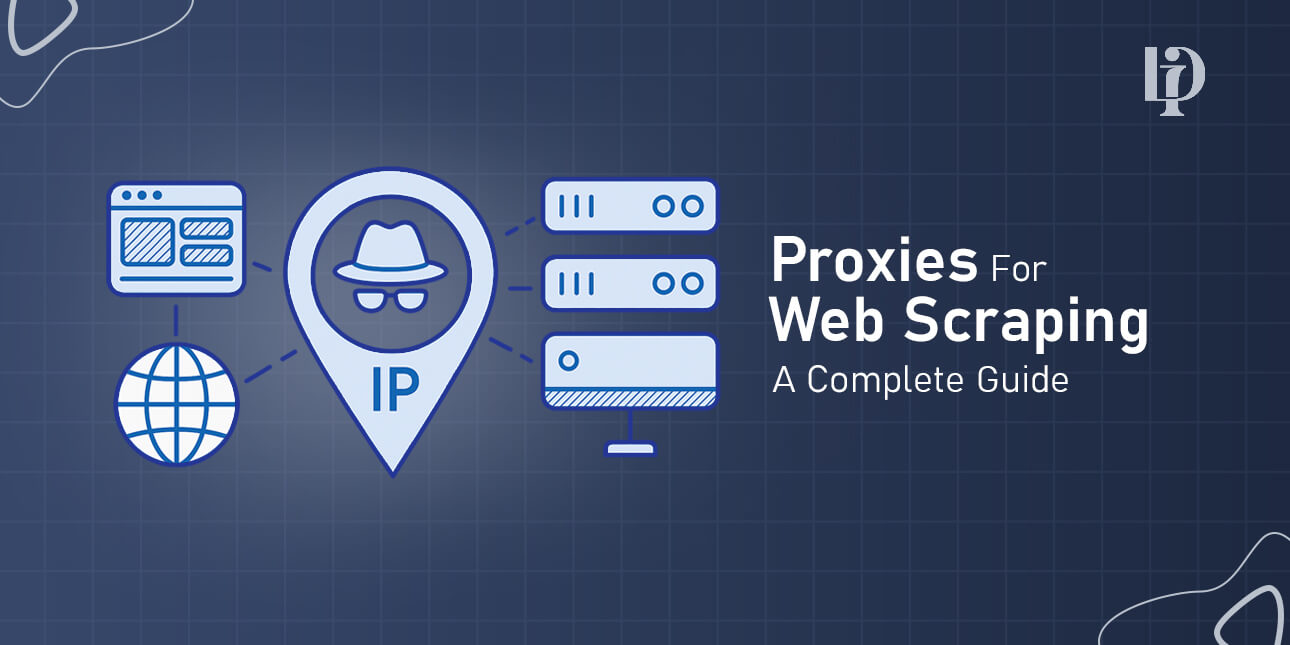
A proxy server is a gateway that accurately routes your internet traffic through an intermediate server before it reaches the destination website. When a request reaches a proxy, the target website inspects the proxy’s IP address and not yours. This is a functioning of a proxy that offers anonymity to the request generator and bypasses certain website restrictions.
A web scraping proxy can easily handle HTTP, HTTPS, and SOCKS protocols and makes your web scraping efforts more simple and direct.
Mostly, websites restrict the number of requests from a single IP address each day. It is called IP-based rate limiting. If you don’t use a proxy scraper, you might get banned when you send repetitive requests from a single IP address. With a proxy, you can send multiple requests without getting banned. Furthermore, proxies also help enable access to a geo-restricted content by routing traffic through servers in different countries.
What Are the Components of a Proxy Server?
To understand proxies, you need to understand their key components. We have discussed them in brief:
- IP Address: it is the unique identifier that the proxy scraper presents to the target website.
- Port: it is the communication endpoint, often defaulting to 80 for HTTP or 443 for HTTPS.
- Authentication: Many proxies ask for usernames and passwords to tighten security.
- Rotation: Some proxies for web scraping automatically cycle through multiple IPs to distribute requests.
Remember that proxies are not just to hide your identity, they also help in improving the performance by caching data and compressing traffic.
Reasons to Use Proxies for Web Scraping
The main reason to use the web scraping proxy service is to gain access to websites while hiding your identity. As websites employ anti-bot mechanisms to prevent web scraping and monitor request patterns, like frequency, user-agent strings, and IP origins.
This is one thing. There are many other reasons to use proxies for web scraping.
- To bypass Geo-Restrictions: Proxies also help website scrapers to appear as if they are browsing from different countries. It helps in unlocking region-specific content.
- Scaling Operations: for large data scraping projects, you might need to send and distribute requests across multiple IPs to avoid rate limits. Proxies play a huge role in this by facilitating it through rotation.
- Anonymity and Privacy: when you mask your real IP, you can avoid legal and other issues like DDoS attacks.
- Improved Success Rates: When you use high-quality proxies, it reduces connection errors and timeouts. It leads to more reliable and accurate data extraction.
Without proxies, your web scraping strategy might not work as in a few request attempts, you might get banned. For example, eCommerce websites like eBay and Amazon limit requests per IP to prevent price scraping.
Types of Proxies for Web Scraping
This is the main part. It is the time to discuss different types of web scraper proxies that are used by businesses. It is important to use the right proxy server for your data scraping requirements. Each of these proxies we have discussed here offers different levels of anonymity, speed, and cost.
Residential Proxies:
Residential proxies are one of the most preferred web scraper proxies by businesses and web scraping companies. They use IP addresses assigned by Internet Service Providers (ISPs) to physical devices at home. The best thing about residential proxies is that they look like safe and genuine users trying to browse websites, making it difficult for websites to identify and block.
A research by the Data Center Dynamics Group claims that residential proxies have a 92% of success rate in bypassing advanced anti-bot systems. It shows how effective residential proxies are compared to other proxy types.
Advantages:
- The best success rate for bypassing sophisticated anti-bot mechanisms
- Geographically diverse options available.
- Lowest probability of CAPTCHA triggers.
Limitations
- Significantly higher costs compared to other proxies
- Variable speed and reliability
- A few ethical concerns related to website consent as some residential proxies come from peer-to-peer networks.
Best Use Cases
- Large video extraction from YouTube
- eCommerce price monitoring
- Ad verification across different regions
- Social media multiple account management
- Stock market research
Data-Center Proxies
Data-center proxies originate from cloud servers in data centers. They are quick and cheaper compared to residential proxies as they are not affiliated with ISPs. However, they can be traced easily by anti-bot mechanisms, especially advanced ones.
Advantages
- High speed and high reliability
- Very cost-effective for large-scale operations
- Easy to scale and manage compared to residential proxies
Limitations
- Higher detection rates by sophisticated anti-bot mechanisms
- IP ranges often blacklisted by major websites
- Limited geographical diversity
Best Use Cases
- Web scraping from websites with basic security measures
- Price monitoring for eCommerce websites
- SEO tracking and competitor analysis
- App testing across different locations
Mobile Proxies
It is the niche-specialist scraping proxies that use IP addresses assigned to mobile devices by cellular networks. If you are scraping mobile-specific websites or platforms that can differentiate between mobile and desktop traffic, it is a valuable proxy tool for you.
Advantages
- Extremely low suspicion from target websites
- Essential for mobile app data scraping
- High rotation capabilities
Limitations
- Very expensive compared to other proxy scrapers
- Limited availability in some regions
- Potentially unstable connections
Best Use Cases
- Social media account management
- Mobile-specific content scraping
- Ad verification across regions
- Online privacy enhancement
ISP Proxies
It is actually a hybrid approach that some web scrapers use. Here, they combine the legitimacy of residential IPs with the speed and reliability of data-center infrastructure. Generally, they are hosted in data centers, but use IP addresses assigned by ISPs.
Advantages
- Excellent balance of legitimacy and performance
- Better pricing compared to the residential proxy approach
- Very effective and accurate for eCommerce platform scraping
Disadvantages
- Limited providers in the market
- Still more expensive than data-center proxies
Best Use Cases
- Content aggregation for news and pricing
- Testing geo-restricted content scraping
- Personal web browsing anonymity
Proxy Rotation and Management
Just acquiring a few proxies is not enough for any web scraping project. You need to design and implement a proxy rotation and session management strategy to handle millions of requests without being banned from targeted websites.
The Importance of IP Rotation
The main objective of using the IP rotation strategy is to ensure that a single IP address does not send enough requests to trigger a rate limit.
Per-Request Rotation: A new IP address is used every time for a new request. If you want to collect a high volume of unstructured, raw data, this is the ideal rotation strategy.
Sticky Sessions: here, the same IP address is used and maintained for a particular duration or a particular number of requests. It is the best way to navigate through different steps like login, CAPTCHAs, forms, adding items in the cart, etc.
Building a Smart Proxy Manager
If you want to establish a high-performance scraping infrastructure, you will need more than a random rotation strategy, you will need smart management.
Failure and Retry Logic: if a particular proxy fails to fetch data, it will be removed from the active pool immediately for a cool-down period. The failed request will be retried with a fresh IP address.
Proxy Health Monitoring: Here, proxies are monitored continuously to track the success rate and response time. Poor-performing IPs are flagged and retired from the pool to improve the scraping efficiency.
Geo-Targeting Control: The smart proxy server infrastructure must be capable of allowing you to specify the required country or even city, for specific geo-restricted content requests.
Which Web Scraping Proxy to Use for Your Project?
The million-dollar question is which web scraping proxy server to use for your project.
Each project has different requirements and different challenges. Hence, it is crucial that you first analyze your project requirements and then choose the right proxy for web scraping for your project.
There are some key factors to keep in mind while choosing a web scraping proxy for your project.
Request Volume
What is the number of requests you want to send for a day? What is the size of the target website? Large websites with robust anti-bot mechanisms will require a more advanced proxy tool. If you want to send more requests per minute, you need to choose a web scraping proxy accordingly.
IP Quality
You can choose any of the web scraping proxies as per the IP quality you need for your project. For example, residential proxies offer the best IP quality and the best successful rates. On the other hand, low-quality IP addresses will be banned by the big websites.
Geographical Coverage
Before choosing a web scraping proxy, ensure that the proxy service’s location coverage matches your target regions. Regional coverage matters if you want to scrape websites locally or internationally.
Bandwidth and Speed
Another thing to check before finalizing a web scraping proxy is bandwidth limit. In addition to that, check latency rates and transfer rates as well. Higher bandwidth facilitates you with faster data collection.
Cost Structure
Also, you can check the cost structures of different proxies for web scraping. Most businesses go for fixed price models in case of consistent scraping needs. If your needs are inconsistent, you can go for a pay-as-you-go model.
Wrapping Up
We have discussed the proxy universe in detail with different types of proxies, their advantages, limitations, and use cases. Choosing the right website proxy scraper for your scraping needs is crucial. Analyze your requirements, proxy types, and choose the right one for your project.
Diya InfoTech is a leading web scraping company that focuses on delivering best-in-class web scraping services by utilizing the best technologies and resources. Discuss your web scraping requirements with them and let them deliver business-centric, customized, and robust web scraping services.